How Does Crypto Lending Work?
Understanding how does crypto lending work is essential for anyone looking to leverage their digital assets for passive income or liquidity without selling their holdings. At its core, the process functions similarly to traditional banking, where depositors provide funds that are then lent to borrowers, with interest distributed among the participants.
By using blockchain technology and smart contracts, these systems automate the exchange of value, ensuring that terms are enforced transparently and efficiently. Whether you are seeking to earn interest on your idle holdings or require a loan using your tokens as security, grasping the mechanics of this financial model is the first step toward participation.
The Core Mechanism of Crypto Lending
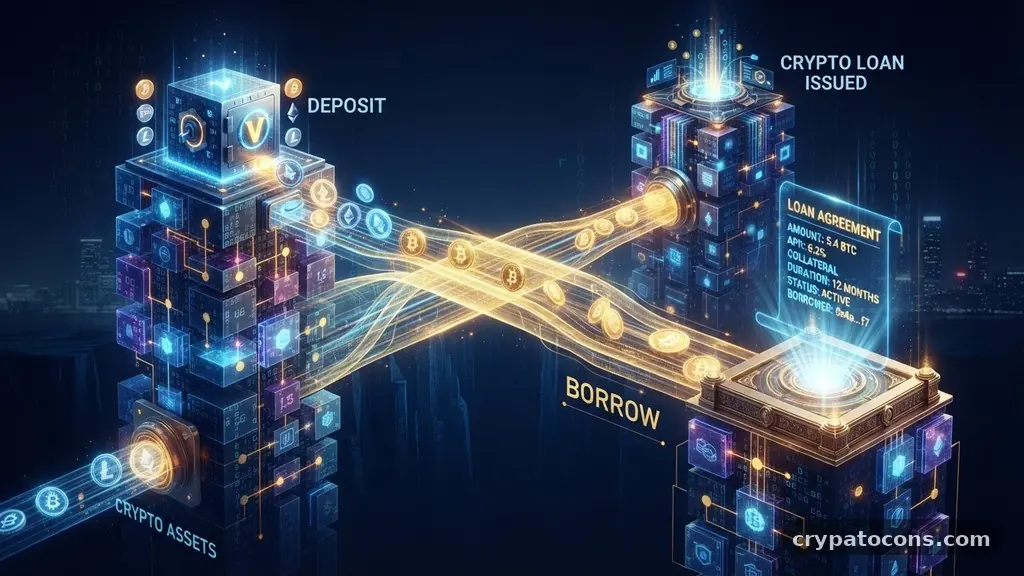
To understand how does crypto lending work, you must first visualize the relationship between three primary entities: the lender, the borrower, and the platform. Lenders deposit their digital assets into a liquidity pool managed by a protocol or a centralized service.
These assets are then made available for borrowers who need liquidity but do not want to liquidate their current positions. The borrower provides collateral to secure the loan, ensuring the lender is protected even if the market experiences significant volatility.
The entire process is governed by code, often in the form of smart contracts on decentralized networks. When a borrower requests a loan, the contract automatically checks that the collateral provided meets the necessary loan-to-value (LTV) ratio.
If the collateral is sufficient, the funds are released to the borrower instantly, while the collateral is locked within the contract. This eliminates the need for intermediaries like banks, reducing overhead costs and speeding up the approval process.
Interest rates are typically determined by supply and demand within the liquidity pool. When many people want to borrow a specific asset, the interest rate for that asset rises, which in turn attracts more lenders to deposit their holdings.
Conversely, when there is an oversupply of an asset, the rates decrease to encourage more borrowing. This dynamic pricing mechanism is a hallmark of decentralized finance (DeFi), providing a market-driven approach to interest rates that reacts in real-time to user behavior.
Types of Crypto Lending Platforms
There are two primary categories of services where you can engage in these activities: centralized and decentralized. Centralized finance (CeFi) platforms function like traditional digital banks, where you entrust your assets to a company that manages the lending and borrowing.
These platforms often require identity verification and store your assets in their own wallets. They are generally more user-friendly for beginners, as they offer customer support and a familiar interface similar to online brokerage accounts.
Decentralized finance (DeFi) platforms operate entirely on the blockchain through smart contracts without a central authority. You maintain control of your private keys and interact directly with the protocol, which provides a higher degree of transparency and censorship resistance.
While this offers more autonomy, it also places the responsibility of security and asset management entirely on the user. If you lose your keys or interact with a faulty contract, there is no support team to help you recover your funds.
Comparing Lending Environments
| Feature | Centralized Platforms (CeFi) | Decentralized Protocols (DeFi) |
|---|---|---|
| Control | Platform manages assets | User retains custody |
| Interface | User-friendly, web-based | Technical, requires wallet |
| Verification | KYC/AML required | Permissionless/Anonymous |
| Support | Customer service available | Community-led, no central help |
How Collateral Secures the Loan
Collateral is the fundamental safety net that makes crypto-backed loans possible. Because cryptocurrencies are inherently volatile, lenders require borrowers to deposit more value in assets than they are actually borrowing.
This is known as over-collateralization. For example, if you want to borrow $5,000 worth of stablecoins, the protocol might require you to deposit $10,000 worth of Bitcoin or Ethereum.
The loan-to-value (LTV) ratio determines how much you can borrow against your holdings. A common LTV ratio might be 50%, meaning for every $100 of collateral, you can borrow $50 worth of assets.
If the value of your collateral drops significantly, the protocol may trigger a liquidation event to protect the lender. During liquidation, the system automatically sells a portion of your collateral to cover the outstanding debt and any associated fees, effectively closing the loan position.
This automated safety mechanism is what allows lenders to participate with confidence. They don’t need to perform credit checks or assess the personal financial history of the borrower.
Instead, they rely on the mathematical certainty of the smart contract to ensure that the loan remains backed by sufficient value at all times. This shift from “trusting the borrower” to “trusting the code” is a revolutionary aspect of how crypto lending works.
Earning Passive Income as a Lender
For those wondering how to generate yield, providing liquidity to a platform is a common strategy. When you deposit your assets, you are essentially acting as a bank, allowing others to use your capital in exchange for interest payments.
The interest is paid out periodically, often compounded over time, which can lead to significant growth if held for long periods. You can view the current state of interest rate markets through resources like Investopedia’s explanation of crypto lending to gain a broader perspective on the sector.
The returns you earn are proportional to the risk and the demand for the specific asset you are lending. Stablecoins, which are pegged to fiat currencies, often have more predictable interest rates compared to volatile assets like Ethereum or Solana.
However, some investors prefer to lend volatile assets to earn interest while simultaneously betting on the long-term price appreciation of the underlying coin. It is important to remember that these yields are not guaranteed and can fluctuate rapidly based on market conditions.
Before depositing your assets, you should evaluate the platform’s history and security audits. Reputable platforms undergo regular third-party code reviews to ensure there are no vulnerabilities that could lead to a loss of funds.
You should also consider the lock-up periods, if any, which might restrict your ability to withdraw your assets immediately. Some platforms offer flexible terms, while others may require you to commit your capital for a set duration to earn higher interest rates.
Key Risks to Consider
While the potential for high returns is attractive, the risks associated with crypto lending are substantial. Smart contract risk is perhaps the most significant, as a bug in the code could allow hackers to drain the liquidity pools.
Even if a protocol has been audited, there is never a 100% guarantee that the code is free of errors. This is why many experienced users diversify their deposits across multiple protocols rather than keeping all their assets in one place.
Market volatility is another critical risk factor, especially for borrowers. If the market value of your collateral crashes suddenly, you could face liquidation, resulting in the loss of your assets.
Lenders also face the risk of impermanent loss or the potential for the platform to become insolvent. If a centralized lender manages your funds and makes poor investment decisions with those assets, you could potentially lose your entire deposit.
Regulatory uncertainty adds another layer of complexity. Governments around the world are still developing frameworks for how to regulate digital assets and lending services.
New rules could impact the legality, accessibility, or tax treatment of your earnings. Staying informed about the regulatory environment in your jurisdiction is an essential part of managing your financial strategy in the digital asset space.
Managing Your Risk Exposure
To protect your capital, you must employ a strategy that prioritizes security over chasing the highest possible yield. One effective way to manage risk is to stick to well-established, blue-chip assets like stablecoins, Bitcoin, or Ethereum. These assets generally have deeper liquidity and are less prone to the extreme price swings that can lead to sudden liquidations of smaller, more speculative coins.
Another strategy is to monitor your LTV ratios closely if you are a borrower. Don’t borrow the maximum amount allowed by the platform, as this leaves you with very little buffer in the event of a market downturn.
Keeping your LTV low ensures that even if your collateral drops in value, you won’t immediately trigger a liquidation event. It is a balancing act between accessing the liquidity you need and maintaining a safety cushion.
Regularly auditing your own portfolio is just as important as checking the platform’s security. Set reminders to review your interest rates and the overall health of the protocols you are using.
If you notice a sudden, unexplained spike in interest rates or a significant change in the platform’s terms of service, it may be time to reassess your involvement. Staying proactive is the best defense against unforeseen market shifts.
Common Use Cases for Borrowers
Many users utilize crypto-backed loans to avoid the tax implications of selling their assets. In many jurisdictions, selling your cryptocurrency for a profit is a taxable event, which can significantly reduce the amount of capital you have left to reinvest.
By taking out a loan against your crypto, you can access cash for living expenses or other investments without triggering a taxable sale. This allows you to retain ownership of your assets, potentially benefiting from future price increases.
* Leverage: Borrowers often use loans to purchase more of their favorite assets, effectively leveraging their position to increase potential gains.
* Tax Efficiency: Accessing cash without selling minimizes capital gains tax burdens in many regions.
* Business Funding: Entrepreneurs use their crypto holdings as collateral to secure working capital for their businesses without liquidating their digital portfolio.
* Short-Term Liquidity: Individuals use these loans to cover emergency expenses without having to sell their long-term holdings during a market dip.
Frequently Asked Questions
Is it possible to lose all my money in crypto lending?
Yes, it is possible. Risks include smart contract failure, platform insolvency, and market volatility that leads to liquidation. You should only lend or borrow with an amount of capital you are prepared to lose.
Do I need a credit check to get a crypto loan?
No, one of the primary benefits of this system is that it is permissionless. Your eligibility is based entirely on the collateral you provide, not on your personal credit history or income verification.
How is the interest rate calculated?
Interest rates are typically calculated by algorithms based on the supply and demand of the specific asset in the liquidity pool. When demand for borrowing is high, rates increase to attract more lenders.
What happens if I don’t pay back my loan?
If you fail to maintain your collateral requirements, the platform will automatically liquidate your assets. This process sells your collateral to repay the debt, and you forfeit the assets you provided as security.
Can I withdraw my money at any time?
It depends on the platform and the specific terms of your deposit. Some protocols allow for instant withdrawals, while others may have lock-up periods or require a notice period before you can reclaim your capital.
Navigating the Future of Digital Finance
Understanding how does crypto lending work provides a clear window into the future of decentralized finance. By removing the traditional gatekeepers, these systems offer a more inclusive and automated way to manage wealth and access liquidity.
Whether you are aiming to put your idle assets to work or need to bridge a gap in your personal cash flow, the flexibility of these protocols is hard to ignore. As the technology matures, we can expect to see more sophisticated tools, better security measures, and clearer regulatory guidelines that will likely make the process even safer for the average user.
As you explore these opportunities, remember that the speed and autonomy of the digital asset world come with increased personal responsibility. Take the time to research each platform, understand the underlying risks of the assets you choose, and always prioritize the security of your private keys.
The ability to participate in global lending markets from your own device is a powerful capability, but it requires a disciplined approach. Start small, stay informed, and continue to learn as the ecosystem evolves to ensure you are making the most of your digital holdings.