What Is a DeFi Liquidity Pool?
A DeFi liquidity pool acts as the lifeblood of decentralized finance, enabling users to swap tokens without the need for a traditional order book. By locking assets into a smart contract, participants create a reservoir of capital that facilitates instant trades across decentralized exchanges.
If you have ever wondered how a platform like Uniswap handles thousands of transactions without a central intermediary, you are looking at the mechanics of a DeFi liquidity pool. Understanding how these pools function is essential for anyone looking to participate in yield farming or provide market depth to the broader crypto ecosystem.
The Core Mechanics of a DeFi Liquidity Pool
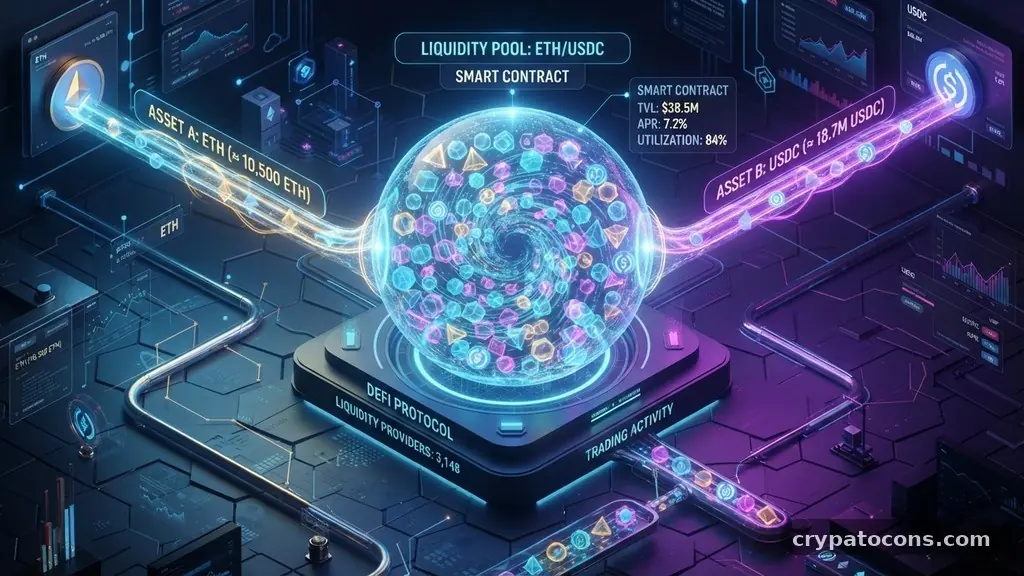
At its heart, a liquidity pool is a smart contract that holds two or more tokens in a specific ratio. Instead of matching a buyer with a seller, the protocol uses an Automated Market Maker (AMM) algorithm to determine the price of the assets.
When a trader wants to swap one token for another, they interact directly with the pool rather than waiting for a counterparty to appear. This mechanism ensures that trading remains decentralized and available twenty-four hours a day.
When you deposit assets into a pool, you become a liquidity provider, often referred to as an LP. In exchange for your contribution, the protocol rewards you with a portion of the trading fees collected from other users.
These fees are distributed proportionally based on your share of the total liquidity in the pool. The more capital you provide, the larger your slice of the generated revenue becomes over time.
The mathematical backbone of most AMMs is the constant product formula, typically expressed as x * y = k. In this equation, x and y represent the quantities of the two tokens, and k is the constant product that must remain steady during a trade.
If a trader buys token A, the pool’s supply of token A decreases while the supply of token B increases. Because the total product must remain constant, the price of token A rises relative to token B, which naturally discourages excessive depletion of the pool.
The Role of Liquidity Providers
Liquidity providers are the individuals who lock their crypto assets into a protocol to ensure the market remains functional. Without these contributors, decentralized exchanges would suffer from high slippage, making it difficult for traders to execute large orders.
Slippage occurs when the price of an asset changes significantly between the time you place an order and the time it is executed. By increasing the depth of the pool, LPs minimize this impact and create a more efficient trading environment.
To become an LP, you generally need to deposit an equal value of two different tokens, such as ETH and USDC. Once your deposit is confirmed, you receive Liquidity Provider tokens, or LP tokens, as a receipt of your stake.
These tokens represent your specific share of the pool’s total value. When you decide to withdraw your funds, you burn these LP tokens to redeem your original deposit plus any accrued trading fees.
It is important to note that being an LP is not entirely risk-free. You are essentially betting that the assets you deposit will maintain a stable relative value.
If one asset in the pool appreciates significantly against the other, you may experience something known as impermanent loss. This happens because the AMM rebalances the pool to maintain the constant product, which may result in you holding more of the depreciating asset and less of the appreciating one.
Comparing Traditional Exchanges and Decentralized Pools
The difference between centralized exchanges and decentralized liquidity pools is stark. Centralized platforms rely on order books where buyers and sellers place limit orders at specific price points.
If there is no one willing to take the other side of your trade, the transaction does not occur. This model is efficient for high-volume markets but can be slow and illiquid for smaller, niche assets.
Decentralized pools solve this by removing the need for a matching engine entirely. Because the liquidity is always present in the smart contract, trades are near-instantaneous regardless of the market conditions.
This shift toward permissionless, automated systems is a defining feature of the decentralized finance landscape. The following table highlights the primary differences between these two systems.
| Feature | Centralized Exchange | DeFi Liquidity Pool |
|---|---|---|
| Intermediary | Required (Exchange) | None (Smart Contract) |
| Trading Mechanism | Order Book | Automated Market Maker |
| Availability | Varies by market depth | Always available |
| Custody | Centralized/Platform | Self-Custody (User) |
Understanding Yield Farming and Rewards
Yield farming is a popular strategy where users move their assets between different liquidity pools to maximize their returns. Beyond the standard trading fees, many protocols offer additional incentives in the form of governance tokens.
These tokens allow holders to vote on protocol upgrades and influence the future direction of the project. This “liquidity mining” approach has been a major driver of growth for many DeFi platforms.
To succeed in yield farming, you must carefully calculate your potential gains against the risks of smart contract vulnerabilities. While the annual percentage yield (APY) might look attractive, it can fluctuate wildly based on market volatility and the total amount of capital staked in the pool. Experienced LPs often use specialized dashboards to track their performance across multiple chains and protocols.
* Diversification: Spreading capital across different pools to mitigate specific asset risk.
* Fee Collection: Earning a percentage of every swap executed within the pool.
* Governance Rights: Participating in the DAO decisions by holding earned protocol tokens.
* Incentive Programs: Taking advantage of temporary liquidity mining campaigns for higher yields.
The Reality of Impermanent Loss
Impermanent loss is the most significant hurdle for new liquidity providers. It occurs when the price of the tokens in your pool changes compared to when you deposited them.
Because the AMM is designed to keep the value of the two assets in balance, the pool will sell the asset that is rising in price and buy the asset that is falling. If you had simply held the tokens in your wallet, you would have made more profit than the fees you earned from the pool.
This loss is called “impermanent” because it only becomes realized if you withdraw your liquidity while the price divergence exists. If the prices of the two tokens return to their original ratio, the loss disappears.
However, in a volatile market, the prices may never return to the initial state. Investors must weigh the potential for fee income against the risk of their assets underperforming a simple “buy and hold” strategy.
Advanced protocols are now experimenting with concentrated liquidity to help mitigate these issues. By allowing LPs to choose the price range in which their capital is active, providers can earn higher fees on their deposits.
While this increases capital efficiency, it also requires more active management to ensure the pool remains within the desired price range. It is a balancing act that requires a solid grasp of market trends and technical proficiency.
Smart Contract Risks in DeFi
Operating within a DeFi liquidity pool requires trusting the code that governs the protocol. Because everything is automated, there is no customer support to reverse a transaction if something goes wrong.
Smart contracts are essentially digital agreements that execute automatically when specific conditions are met. If a developer makes a mistake in the code, or if a hacker finds a vulnerability, the funds in the pool could be at risk.
Audits are the primary defense against these types of failures. Reputable projects hire independent security firms to review their code and identify potential bugs before the protocol goes live.
Before putting your capital into any pool, you should check for public audit reports and look for the project’s history of stability. A lack of transparency or a rushed launch is often a red flag for potential investors.
Beyond code errors, there is also the risk of “rug pulls.” This happens when developers intentionally create a pool with a malicious backdoor or simply drain the liquidity after users have deposited their funds.
To protect yourself, stick to well-established platforms with significant total value locked (TVL) and a long track record of operation. Never deposit money that you cannot afford to lose, as the decentralized nature of these systems means there is no central authority to appeal to in the event of a total loss.
How to Choose the Right Pool
Selecting the right pool depends on your risk tolerance and your goals as an investor. If you are looking for stability, you might choose a pool consisting of two stablecoins, such as USDC and USDT.
These pools generally have lower APYs but carry a much lower risk of impermanent loss. On the other hand, pairing a stablecoin with a more volatile asset like ETH offers a higher potential reward but comes with significantly more risk.
You should also consider the platform’s volume and liquidity depth. A pool with high trading volume will generate more fees, but it might also be more competitive to enter.
Check the platform’s interface for metrics like 24-hour volume and the total value locked. These indicators give you a sense of how much activity is happening and how likely you are to earn a consistent return on your investment.
Finally, remember to account for gas fees, especially on networks like Ethereum. If the cost of depositing and withdrawing your liquidity is higher than the fees you expect to earn, the strategy will not be profitable.
Many users prefer to use layer-two solutions or alternative blockchains with lower transaction costs to make their participation more viable. Always run the numbers before committing your capital to ensure the potential yield covers your overhead costs.
FAQ: Common Questions About Liquidity Pools
Can you actually make money in liquidity pools?
Yes, you can earn income through trading fees and liquidity mining rewards. However, your actual profit depends on the trading volume of the pool and the market movement of the assets you provided. You must subtract any potential impermanent loss from your earnings to see your true net gain.
How do I get my money out of a DeFi pool?
Removing your liquidity is usually a simple process. You navigate to the platform where you provided liquidity, select your active position, and click the withdraw or remove button. The smart contract will then burn your LP tokens and return your original assets, along with any accumulated fees, to your connected wallet.
Is it possible to lose all my money in a liquidity pool?
Yes, there is a risk of losing your principal. This can happen through extreme impermanent loss, a smart contract hack, or a malicious “rug pull” by the project developers. Always research the project thoroughly and never invest more than you are prepared to lose entirely.
Do I need to be an expert to provide liquidity?
You do not need to be a developer, but you should have a basic understanding of how crypto wallets and gas fees work. It is also helpful to understand the concept of impermanent loss and how to read basic price charts. Start with small amounts to learn how the process works before committing larger sums.
What happens if the price of the tokens drops to zero?
If one of the tokens in your pool loses all its value, your position will be heavily impacted. The pool will essentially become filled with the worthless token, and you will lose the value of the other asset you deposited. This is why it is critical to choose assets with long-term viability and strong market support.
Final Thoughts on Participating in DeFi
A DeFi liquidity pool represents a fundamental shift in how markets operate, giving individuals the power to become market makers. By providing the essential capital that decentralized exchanges need to function, you can earn a passive income while supporting the growth of open finance. The transition from traditional, centralized finance to this permissionless model is one of the most exciting developments in the crypto space.
As you begin your journey, remember that the technology is still evolving rapidly. Stay curious, prioritize security, and always perform your own due diligence before locking your assets into any smart contract.
While the potential for high yields is a significant draw, the long-term goal of these systems is to build a more transparent and accessible financial infrastructure for everyone. By understanding the mechanics of a DeFi liquidity pool, you are well-positioned to navigate this space with confidence and clarity.