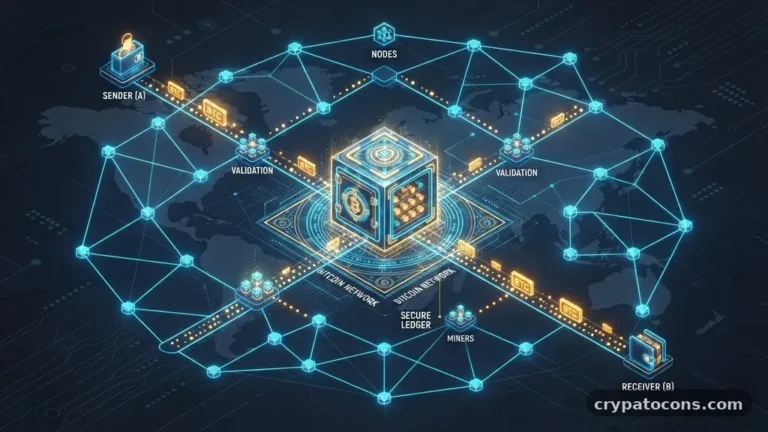

What Is Restaking in Crypto?
Restaking in crypto represents a significant evolution in how blockchain networks secure their infrastructure while allowing users to maximize the utility of their digital assets. By enabling the reuse of already staked tokens to validate additional protocols, this mechanism creates a new layer of efficiency for decentralized finance participants.
Understanding this concept is essential for anyone looking to optimize their portfolio or engage more deeply with the underlying architecture of modern blockchains. This article breaks down the mechanics, potential gains, and inherent trade-offs involved in this advanced staking strategy to help you make informed decisions about your holdings.
The Core Mechanics of Restaking
At its most basic level, restaking allows you to take tokens that are already locked in a staking contract and use them to secure another decentralized service or application. Traditionally, when you participate in crypto staking, your assets are tied to a single blockchain network to maintain its consensus and security. Restaking breaks this siloed approach by introducing a middleware layer that aggregates these staked assets to support various “Actively Validated Services” (AVS).
Think of your staked assets as a security deposit that is currently only doing one job. By opting into a restaking protocol, you are effectively allowing that same deposit to serve as collateral for additional networks simultaneously.
This process is made possible by smart contracts that verify the underlying stake on the primary chain and then extend that security to other modular services. You aren’t moving your tokens in the traditional sense, but rather delegating the verification power of those tokens to multiple systems.
This architecture aims to solve the “bootstrapping” problem for new blockchain projects. Instead of building a massive validator set from scratch, a new protocol can leverage the existing, high-value pool of assets already secured on a major chain. This creates a symbiotic relationship where the new service gains immediate security, and the asset holder earns extra rewards for providing that secondary layer of protection.
How Restaking Differs from Standard Staking
Standard crypto staking is the foundational process of locking up digital assets to support a blockchain network, such as Ethereum, in exchange for regular payouts. In this model, your assets are fundamentally linked to the health of that one specific chain. If that network is secure and active, you earn rewards; if you choose to unstake, you generally face a waiting period known as an unbonding duration.
Restaking takes this foundation and adds a level of complexity by creating a tiered security structure. While standard staking is a binary state—either you are staking or you are not—restaking is additive. You retain your primary stake on the base layer, but you effectively “sub-lease” your security to other protocols.
The primary difference lies in the breadth of exposure and the nature of the risks involved. In a standard setup, you are only exposed to the risks of the parent chain, such as slashing for validator downtime or network-specific bugs.
When you engage in restaking, you are potentially exposed to the slashing conditions and technical failures of every additional service you choose to secure. It is a trade-off between higher yield potential and a broader surface area for potential losses.
The Role of Actively Validated Services
Actively Validated Services, often referred to as AVS, are the backbone of the restaking ecosystem. These are decentralized protocols that require their own distributed validation mechanisms to function correctly.
Examples include data availability layers, cross-chain bridges, or decentralized oracle networks. These services need a way to ensure that the participants validating their data are honest and incentivized.
Before restaking existed, these services had to issue their own tokens and build a validator community from the ground up. This was often an expensive and slow process that created significant barriers to entry. By utilizing restaking, these services can tap into the immense economic security provided by existing, battle-tested assets.
When you restake, you are essentially signaling your trust in these AVS protocols. You are telling the network that your assets should be slashed if these services fail to operate correctly.
In return for taking on this responsibility, the AVS typically pays you a premium in their native tokens. This creates a multi-layered incentive structure that rewards users for helping secure the broader decentralized web.
Risks and Security Considerations
It is crucial to recognize that restaking is not a risk-free endeavor. The most prominent concern is the possibility of “slashing,” where a portion of your staked assets is confiscated if the service you are validating behaves maliciously or experiences a technical failure. Because you are securing multiple services simultaneously, a single misconfiguration or bug in one of these protocols could theoretically put your base stake at risk.
Another layer of risk involves the complexity of the smart contracts involved. Every time you interact with a new protocol, you are introducing a new potential point of failure in the form of code vulnerabilities.
If the restaking platform itself has a bug, the underlying assets could be locked, stolen, or incorrectly slashed. Users should always prioritize protocols that have undergone rigorous, multi-party audits and maintain transparent development histories.
Furthermore, there is the risk of “correlation risk.” If many users decide to restake their assets across the same suite of services, a failure in one of those services could lead to a cascading event.
This could potentially destabilize the primary network if the slashing conditions are too aggressive. Diversification is key when navigating this landscape, as spreading your stake across different services can help mitigate the impact of a single protocol failure.
The Economic Incentive Structure
The primary driver for most participants in the restaking ecosystem is the ability to earn additional rewards. By stacking rewards from the base layer with those from multiple AVS protocols, investors can see a significantly higher annual percentage yield compared to standard staking. This has led to a surge in interest from institutional and retail participants looking for ways to maximize the efficiency of their digital portfolios.
To illustrate how this works, consider a hypothetical investor who holds Ethereum. They can stake it on the main network to earn a base return.
By then depositing that stake into a restaking platform, they can secure two additional data-availability services, each paying a small fee in their respective tokens. The following table highlights the conceptual difference in yield potential:
| Strategy | Primary Source | Secondary Source | Relative Yield |
|---|---|---|---|
| Standard Staking | Base Network Rewards | None | Baseline |
| Restaking (Tier 1) | Base Network Rewards | One AVS Protocol | Baseline + 1-2% |
| Restaking (Tier 3) | Base Network Rewards | Three AVS Protocols | Baseline + 4-6% |
These figures are estimates and fluctuate based on market demand for decentralized services and the total amount of assets locked in the system. As more AVS protocols join the ecosystem, the potential for diversified income streams grows. However, the increased yield must always be weighed against the technical and security risks outlined in previous sections.
Getting Started with Restaking
If you are interested in participating, the first step is to ensure you have compatible assets, typically liquid staking tokens or native tokens that are supported by the restaking platform. Many users start by using established platforms like EigenLayer, which provides a framework for restaking on the Ethereum blockchain. You will need a secure, non-custodial wallet to interact with these protocols directly.
Once you have your assets ready, you will typically connect your wallet to the restaking interface. From there, you can choose which AVS protocols to delegate your stake to.
It is important to read the documentation for each service to understand their specific slashing conditions and rewards structure. Some platforms offer “liquid restaking tokens,” which allow you to retain liquidity while your assets are actively securing other networks.
* Verify the smart contract addresses before interacting with any platform.
* Start with a small amount to understand the UI and the withdrawal process.
* Monitor your positions regularly to ensure the AVS protocols you chose remain active.
* Diversify your delegations across multiple services to spread your risk.
* Keep track of tax reporting requirements for the additional rewards you earn.
The process is designed to be relatively straightforward, but the underlying complexity is high. Always take your time to understand the implications of the protocols you are engaging with. Never stake more than you are prepared to lose, especially in the early stages of a new technology.
The Evolution of Modular Security
Restaking is a fundamental component of what many call the “modular blockchain” thesis. Instead of one single blockchain trying to do everything—execution, settlement, consensus, and data availability—the industry is moving toward a specialized model. In this model, different layers handle different tasks, and security is shared across the entire ecosystem.
This shift allows for greater scalability and innovation, as developers can focus on building high-performance execution layers without needing to worry about the massive capital requirements of securing a network. Restaking acts as the glue that binds these modular pieces together. By allowing capital to flow freely between services, it ensures that the most important parts of the infrastructure are always backed by the most secure assets.
As this technology matures, we can expect to see more sophisticated automated strategies. These might include AI-driven rebalancing of your stake to maximize rewards while minimizing risk exposure. We are currently in the early days of this architecture, and the tools available to users are likely to become much more user-friendly and automated in the coming years.
Frequently Asked Questions
Is restaking safe for long-term investors?
Restaking involves higher risks than standard staking because your assets are exposed to the security vulnerabilities of multiple protocols. While it offers higher rewards, it is generally considered a more advanced strategy that requires active management and a higher risk tolerance.
Can I withdraw my assets at any time?
Most restaking protocols have a withdrawal period, similar to the unbonding period on mainnet chains. This can range from a few days to several weeks, depending on the specific protocol’s design and the underlying network’s constraints.
Do I need a lot of capital to start?
There is no strict minimum amount required to participate in most restaking protocols, but you should consider the transaction fees on the network. If the gas fees are high, it may not be cost-effective to restake smaller amounts of crypto.
How do I choose which services to support?
You should look for services that have clear, transparent use cases, active development teams, and successful security audits. It is helpful to research the whitepaper of each protocol to understand exactly what their security requirements are and how they plan to incentivize participants.
Is restaking taxable?
In most jurisdictions, rewards earned through staking and restaking are considered taxable income. You should consult with a tax professional who understands cryptocurrency regulations in your specific region to track your earnings correctly.
Final Thoughts
Restaking in crypto serves as a powerful testament to the ingenuity of decentralized finance, turning idle assets into the bedrock of new, specialized protocols. By enabling the reuse of staked tokens, users can contribute to a more secure and efficient blockchain ecosystem while potentially increasing their own yield. However, this added functionality brings new complexities and risks that require careful consideration.
As the industry continues to evolve, staying informed about the protocols you support and the underlying security mechanisms remains the best way to protect your interests. Whether you are a casual participant or a deep-dive researcher, the growth of this sector offers a fascinating look into the future of trustless, shared security. Engaging with these protocols thoughtfully will help you navigate the landscape as it matures.