What Is a Crypto Prediction Market?
A crypto prediction market functions as a decentralized platform where participants trade shares based on the outcome of future real-world events. By leveraging blockchain technology, these systems allow users to speculate on everything from political elections to the future price of digital assets.
Understanding what is a crypto prediction market requires looking at how smart contracts replace traditional intermediaries, ensuring that payouts are automated and transparent. Whether you are interested in hedging against volatility or simply testing your foresight on global news, these platforms offer a unique intersection of finance, data analysis, and decentralized governance.
The Core Mechanism of Prediction Markets
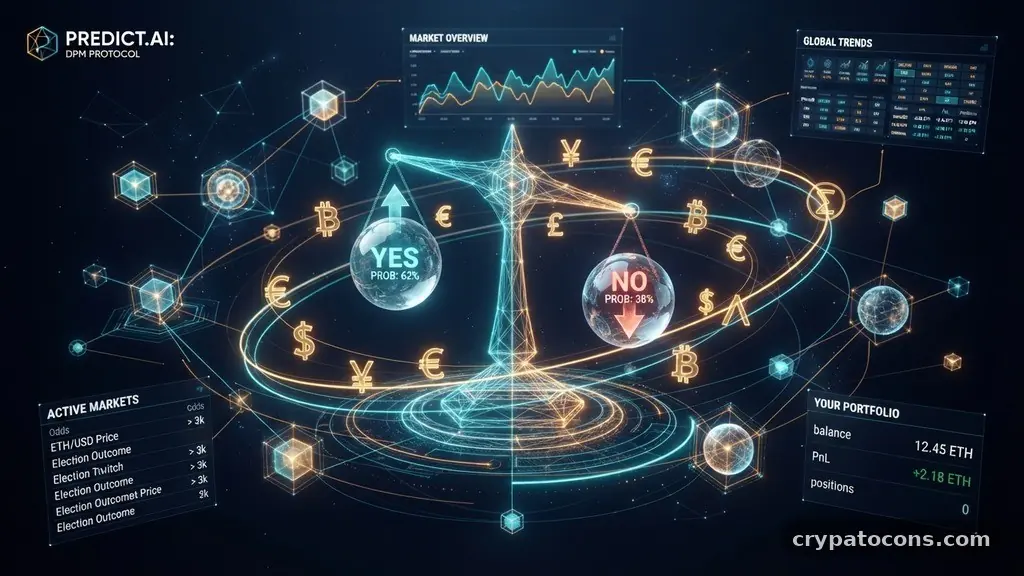
At its simplest level, a prediction market is an exchange designed to aggregate information. Participants buy and sell contracts that represent a “Yes” or “No” outcome for a specific question.
If you believe a certain event will occur, you purchase “Yes” shares; if you think it won’t, you buy “No” shares. The price of these shares typically fluctuates between $0 and $1, reflecting the collective probability assigned by the market to that event.
When the event concludes, the smart contract governing the trade executes automatically. If your prediction was correct, the contract pays out the full value of the share, often $1.
If you were incorrect, the share expires as worthless. This mechanism removes the need for a bookmaker or a central clearinghouse to hold the funds.
Because these platforms run on networks like Ethereum, the rules of the market are baked into the code. No single entity can arbitrarily change the payout terms or freeze your account based on internal policy. This transparency is a significant departure from traditional betting sites where the house holds all the cards.
Why Blockchain Changes the Game
Traditional prediction markets have existed for decades, but they often faced issues with censorship, high fees, and geographic restrictions. A crypto prediction market solves these by being permissionless. Anyone with a digital wallet can participate, regardless of their location, provided they have access to the underlying network.
Smart contracts handle the entire lifecycle of a prediction. From the moment you place a trade to the final settlement, the code ensures the process remains immutable. There is no manual intervention required to verify the results or distribute the winnings.
Furthermore, these markets provide a form of “wisdom of the crowd” data. Because participants are putting their own capital at risk, they are incentivized to research the events thoroughly. This often leads to more accurate probability assessments than what you might find in mainstream media or expert opinion polls.
Types of Events Traded
The diversity of events available on these platforms is perhaps their most compelling feature. While sports betting is common, decentralized markets often focus on more complex topics. You might see markets for the outcome of a central bank meeting, the release date of a new software update, or the volatility of a major asset like bitcoin.
Some markets even track scientific breakthroughs or the success of specific climate initiatives. These are often called “information markets” because they serve as a tool to measure collective belief about the future. By observing the price of a contract, researchers can gauge how the public perceives the likelihood of specific milestones.
Common Market Categories
- Political elections and legislative outcomes
- Macroeconomic indicators like inflation rates
- Technology milestones and product launches
- Cryptocurrency price targets and network upgrades
- Entertainment industry awards and box office performance
The Role of Oracles in Accuracy
One of the biggest challenges for any automated market is determining the actual result of an event. This is where an “oracle” comes into play. An oracle is a service that feeds real-world data into the blockchain so the smart contract knows whether to pay out “Yes” or “No” holders.
If a market is asking who won a specific election, the oracle must report the official, verified results. If the oracle is compromised or inaccurate, the entire market becomes unreliable. Most platforms use decentralized oracle networks, such as Chainlink, to ensure that data is sourced from multiple independent nodes rather than a single point of failure.
Some platforms also use a “dispute resolution” layer. If a user disagrees with the oracle’s report, they can stake tokens to challenge the outcome. This creates a secondary market for truth-seeking, where participants are financially rewarded for reporting the correct data and penalized for attempting to manipulate the result.
Comparing Crypto Markets to Traditional Betting
It is vital to distinguish between a crypto prediction market and traditional sports betting or casino gambling. While both involve risk, the underlying philosophy differs significantly. Betting is usually a zero-sum game designed for entertainment, whereas prediction markets are designed to produce a reliable probability estimate.
The data generated by these markets is increasingly used by analysts to inform their own trading strategies. When a contract for an event shows a 70% chance of happening, that figure is often more accurate than a static poll. This is because the market participants have “skin in the game” and are financially motivated to be right.
| Feature | Traditional Betting | Crypto Prediction Market |
|---|---|---|
| Intermediary | Centralized House | Smart Contract |
| Transparency | Low (Proprietary) | High (On-chain) |
| Barrier to Entry | High (KYC/Geo-blocked) | Low (Wallet-based) |
| Primary Goal | Entertainment/Profit | Information Aggregation |
Risks and Regulatory Hurdles
Despite the technical elegance, participating in these markets is not without danger. The most obvious risk is financial loss.
If your prediction is wrong, you lose the capital you committed to the contract. Furthermore, because these markets are often decentralized, there is no customer support team to call if you make a mistake or if you encounter a bug in the interface.
Regulatory scrutiny is another major factor. Many jurisdictions view these platforms as unregistered securities exchanges or gambling portals. Depending on where you live, accessing these platforms might be restricted, or the legal status of your winnings might be unclear.
Users should also be wary of “liquidity risk.” If a market has very few participants, it may be difficult to exit your position before the event concludes. Always check the volume and open interest on a specific contract before committing significant funds to ensure you aren’t stuck in a stagnant position.
How to Start Trading
If you are ready to engage with these platforms, the first step is setting up a non-custodial wallet. You will need to hold some base tokens—such as ETH or a stablecoin like USDC—to interact with the smart contracts. Most platforms operate on Layer 2 solutions or sidechains to keep transaction fees low, so ensure your wallet is configured for the correct network.
Once your wallet is funded, you can browse the active markets. Look for events with high liquidity, as these usually provide more accurate pricing and easier entry/exit points. Start with small amounts to understand how the platform handles fee structures and event settlement.
Always read the market rules before placing a trade. Each contract has a specific definition of what constitutes a “win.” For example, if you are betting on the price of an asset, the contract will specify which exchange or data source it uses to determine the final price at a specific time.
Frequently Asked Questions
Are these markets actually gambling?
While they share similarities with gambling, they are fundamentally different in purpose. They are designed to aggregate information and provide probability estimates for future events, whereas gambling is typically a game of chance designed for entertainment.
What happens if an event is cancelled?
Most well-designed platforms have a protocol for this. If an event cannot be resolved or is cancelled, the smart contract typically triggers a refund process, returning the locked collateral to the participants based on their share ownership.
Can anyone create a market?
On many decentralized platforms, yes. Anyone can propose a new market by defining the question, the source of truth, and the settlement date. However, these markets may not attract liquidity unless they are clearly defined and interesting to other traders.
How do I know the data source is honest?
Platforms use decentralized oracles and crowdsourced dispute resolution to ensure accuracy. If a reporter provides false data, they face financial penalties, which makes it economically irrational for them to lie.
Do I have to pay taxes on my winnings?
Tax laws regarding digital assets vary by country. In many jurisdictions, gains from trading these contracts are treated as capital gains or income. You should consult a tax professional to understand your local reporting requirements.
Future Outlook
The potential for these markets to reshape how we view global events is immense. As the technology matures, we will likely see more complex contracts that allow for intricate hedging strategies. Imagine a world where a small business can buy a contract that pays out if a specific regulatory change occurs, effectively insuring themselves against policy shifts.
This evolution will rely on better user interfaces and more intuitive ways to interact with complex data. We are already seeing a shift toward mobile-friendly decentralized apps that make it easier for non-technical users to participate. The goal is to move beyond the niche “crypto-native” crowd and bring the benefits of information aggregation to a broader audience.
As we move past this September and into the coming years, expect to see deeper integration between traditional financial data and decentralized prediction platforms. The combination of real-time market data and blockchain-verified outcomes creates a powerful tool for anyone interested in the intersection of finance and prediction.
By understanding what is a crypto prediction market today, you are positioning yourself at the forefront of a significant shift in how information is valued and traded. Start small, conduct your own research, and always remain mindful of the risks inherent in any decentralized financial system.