How Do Ethereum Layer 2 Networks Work?
Understanding how do Ethereum Layer 2 networks work helps you see why the ecosystem is suddenly faster and cheaper to use. By moving the heavy lifting of processing thousands of individual transactions off the main chain, these systems preserve decentralization while drastically improving user experience.
You will learn how these protocols anchor their security to the main Ethereum blockchain, ensuring that your assets remain safe even when you interact with secondary layers. This breakdown explores the technical mechanics, the different types of rollups available, and why these scaling solutions are essential for the future of decentralized finance.
The Fundamental Purpose of Layer 2 Scaling
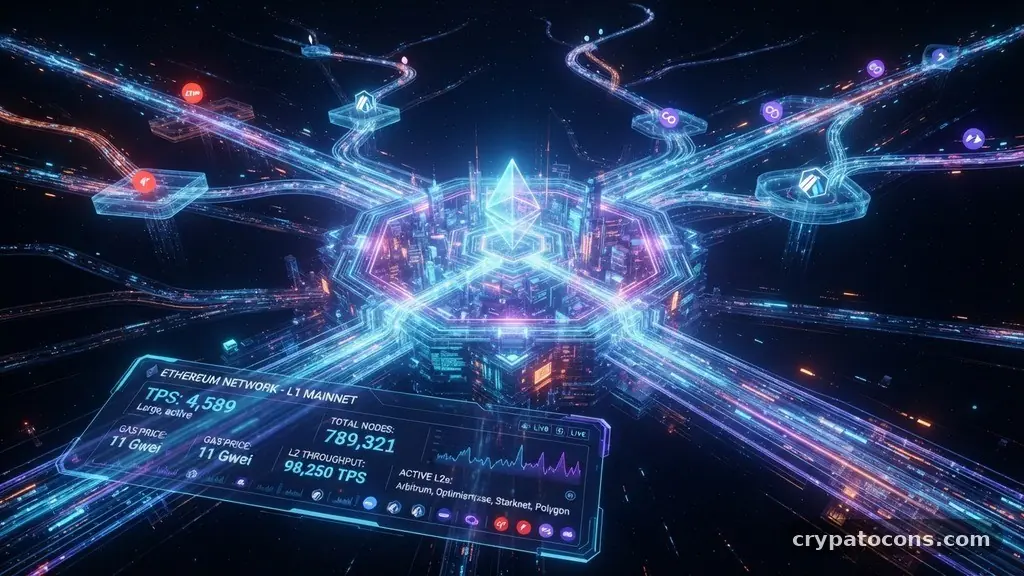
To understand how do Ethereum Layer 2 networks work, you must first recognize the bottleneck on the main chain, known as Layer 1. Ethereum was designed to be secure and decentralized, but those priorities create a natural limit on how many transactions it can process per second.
When too many users compete for space in a block, the network becomes congested and transaction fees skyrocket. This is the classic trilemma of blockchain technology: balancing security, decentralization, and scalability.
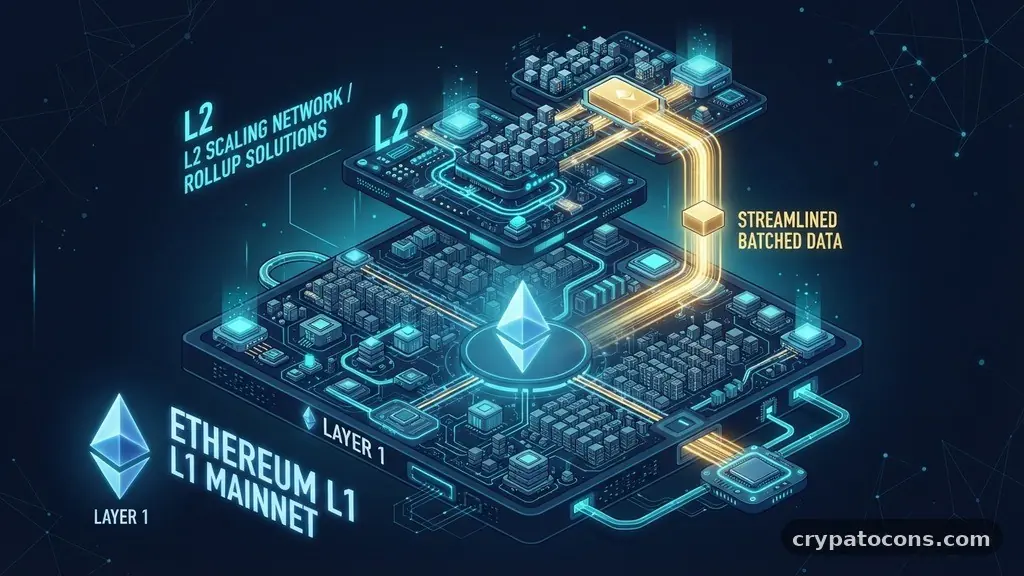
Layer 2 solutions act as a secondary framework built on top of the main chain. They process transactions independently and then report a compressed summary back to the Ethereum mainnet.
By handling the execution phase away from the primary ledger, these networks relieve the pressure on the base layer. Users get the benefit of near-instant finality and significantly lower costs, all while relying on the underlying security of the Ethereum protocol.
How Rollups Handle Data Processing
The most prominent technology currently enabling this efficiency is the “rollup.” A rollup is a mechanism that bundles—or rolls up—hundreds or even thousands of transactions into a single batch.
Instead of Ethereum having to verify every single signature and state change individually, it only needs to verify the validity of that one batch. This drastically reduces the computational burden on the Ethereum nodes.
There are two primary types of rollups: Optimistic and Zero-Knowledge (ZK). Optimistic rollups assume that transactions are valid by default and only run a computation if someone challenges the batch.
ZK-rollups, conversely, use complex cryptographic proofs to mathematically guarantee that every transaction in the batch is legitimate before it is ever sent to the main chain. Both methods achieve the same goal of massive data compression and throughput.
Security Anchoring on the Mainnet
Even though transactions happen on a separate layer, they are not disconnected from the security of the primary network. When a rollup finishes a batch, it submits a small amount of data to the Ethereum mainnet.
This data acts as a permanent record that proves the state of the Layer 2 network at that specific moment. Because this data is published on Ethereum, anyone can verify it independently.
If a malicious actor tries to alter the history of a Layer 2, the cryptographic proofs or the challenge windows inherent in the system will catch the discrepancy. The Ethereum mainnet acts as the ultimate court of law.
It settles disputes and ensures that the state of the Layer 2 remains synchronized with the truth of the base layer. This design ensures that you don’t have to trust the operators of the Layer 2 network; you only have to trust the mathematics of the Ethereum protocol itself.
Comparing Layer 1 and Layer 2 Performance
The difference in performance between the main Ethereum chain and these secondary layers is substantial. While Ethereum Layer 1 might handle between 15 and 30 transactions per second, a well-optimized Layer 2 can handle thousands in the same timeframe. This creates a vastly different environment for developers building decentralized applications.
| Metric | Ethereum Layer 1 | Layer 2 Network |
|---|---|---|
| Transaction Speed | Slow (15-30 TPS) | High (1,000+ TPS) |
| Transaction Fees | Variable (Often High) | Very Low (Cents) |
| Security Model | Directly on-chain | Inherited from L1 |
| Latency | Higher | Near-instant |
Key Components of the Ecosystem
Several distinct architectural elements work together to keep these networks running smoothly. You have the “sequencer,” which is a node responsible for ordering transactions and creating the batches.
You also have the “bridge” contracts, which are smart contracts on the Ethereum mainnet that hold the assets being moved back and forth. These bridges are critical infrastructure, as they lock tokens on the main chain and issue representative tokens on the secondary layer.
The ecosystem is not just one monolithic entity; it is a diverse collection of projects, each with its own trade-offs. Some focus strictly on general-purpose smart contracts, while others are built for specific applications like gaming or high-frequency trading. You can learn more about the technical standards and infrastructure by visiting the official Ethereum documentation on scaling.
Common Challenges and Trade-offs
No technology is perfect, and Layer 2 solutions come with their own set of inherent risks. One of the main concerns is the centralization of sequencers.
Because running a sequencer requires specific hardware and expertise, many early networks rely on a single entity to order transactions. While this is efficient, it introduces a point of failure that the community is actively working to decentralize.
There is also the issue of “bridge risk.” When you move assets from the main chain to a secondary layer, you are effectively trusting the smart contract code of the bridge to safeguard those funds.
If the bridge has a vulnerability, it could lead to significant financial loss. Users should always be aware that while the underlying blockchain is secure, the interface and the bridge code are written by humans and are subject to bugs.
The Role of Data Availability
Data availability is a critical concept in how do Ethereum Layer 2 networks work. For a network to be secure, the data used to calculate the state of the blockchain must be accessible to everyone.
If a rollup operator hides the transaction data, users might be unable to withdraw their funds or prove that their balance is correct. This is why most rollups publish their data directly to the Ethereum mainnet.
Newer iterations, such as “data availability layers,” are being developed to make this even cheaper. Instead of forcing the main chain to store massive amounts of raw transaction data, these specialized networks handle the storage while providing a cryptographic guarantee to Ethereum that the data is available. This evolution is vital for lowering fees even further and allowing for more complex applications to thrive.
Frequently Asked Questions
Is it safe to keep my assets on a Layer 2 network?
Most major Layer 2 networks are considered highly secure because they inherit their security from the Ethereum mainnet. However, you should still exercise caution, as these are newer technologies with more complex codebases than the main chain. Always stick to established, battle-tested networks with high total value locked (TVL).
Can I move my funds back to the Ethereum mainnet at any time?
Yes, you can bridge your assets back to the Ethereum mainnet whenever you choose. Depending on the type of rollup, this might take a few minutes or several days. Optimistic rollups often have a waiting period for withdrawals to ensure that any potential fraud challenges have been resolved.
Do I need to pay for gas in ETH on these networks?
Most Ethereum Layer 2 networks use ETH as the native currency for paying gas fees. This makes the transition for users very simple, as you do not need to purchase a new or obscure token to use the network. The fees are paid in ETH, but they are a tiny fraction of what you would pay on the main chain.
How are Layer 2 networks different from sidechains?
The primary difference is security. A sidechain is an independent blockchain with its own consensus mechanism and security model; if the sidechain fails, your assets could be at risk. A Layer 2 network, by contrast, relies on the Ethereum mainnet to validate and secure its transactions, making it significantly more robust.
Are these networks considered permanent solutions?
They are currently the industry standard for scaling Ethereum. While the community is also working on “sharding” and other Layer 1 upgrades, Layer 2 networks are expected to be the primary way most users interact with the Ethereum ecosystem for the foreseeable future.
Future Outlook for Scaling
The landscape of blockchain scaling is evolving rapidly. As more users flock to decentralized applications, the demand for efficient, low-cost transaction environments will only grow.
Developers are constantly refining the way rollups communicate with the main chain, leading to faster withdrawal times and better user interfaces. It is an exciting period where the limitations that once hindered mass adoption are being systematically removed.
By understanding how do Ethereum Layer 2 networks work, you are better equipped to participate in this growing digital economy. Whether you are trading tokens, minting digital art, or participating in governance, these layers provide the foundation for a more accessible decentralized world.
Stay curious, keep exploring the different protocols, and always prioritize the security of your own keys when interacting with any bridge or network. The tools for a faster internet are being built today, and they are already available for you to use.