Why Are Ethereum Gas Fees High?
Understanding why Ethereum gas fees high levels are reached requires looking at how the network processes data. When you interact with the Ethereum blockchain, you are essentially paying for the computational power required to execute your request. Because the network has a finite capacity for how many operations it can handle at once, users compete for space in each block.
This dynamic pricing model ensures that the most urgent or complex tasks get priority through higher bids. By exploring the mechanics behind these costs, you will gain a clearer picture of how to manage your digital assets more effectively while avoiding unnecessary expenses during periods of heavy market congestion.
The Basic Mechanics of Ethereum Gas
At its core, Ethereum gas acts as a fee paid to validators for the work they perform to keep the network running. Every action on the blockchain, from a simple token transfer to a complex interaction with a decentralized finance protocol, requires a specific amount of computational effort.
This effort is measured in “gas units.” You don’t pay for the actual transaction in dollars, but rather in ETH, which is then converted into a fee based on the current market demand for block space.
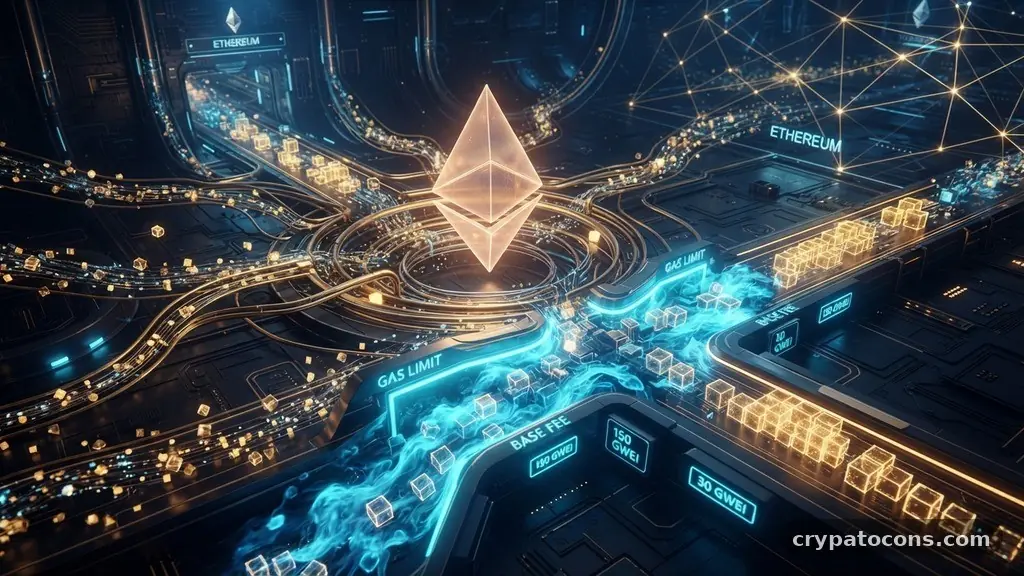
The cost of a transaction is determined by multiplying the gas limit by the gas price. The gas limit is the maximum amount of work you are willing to authorize for a specific transaction, while the gas price is the amount of ETH you are willing to pay for each unit of that work.
If the network is busy, validators will prioritize transactions that offer higher gas prices. This creates a bidding war where users who pay more get their transactions confirmed faster, while those who pay less may find their requests stuck in a pending state for hours or even days.
Supply and Demand in Block Space
The primary reason you might wonder why Ethereum gas fees high spikes occur is simple supply and demand. The Ethereum network has a strict limit on how much data can be included in a single block, which is generated roughly every 12 seconds.
When thousands of users attempt to execute transactions simultaneously, the network reaches its capacity. This congestion forces the protocol to raise the price of admission for anyone wanting to get their data included in the next block.
Think of the Ethereum blockchain like a highway with a set number of lanes. During off-peak hours, traffic flows smoothly and the cost to use the road remains low. However, when a major event occurs—such as a viral NFT mint or a sudden market crash—the highway becomes packed with cars.
To ensure the network doesn’t grind to a halt, the system forces users to outbid one another for the limited space available. This mechanism is essential for network security, but it is also the direct cause of the high costs users experience during busy periods.
Complexity of Smart Contracts
Not all transactions on Ethereum are created equal. A simple transfer of ETH from one wallet to another is a relatively lightweight operation that requires minimal computational resources.
In contrast, interacting with a complex decentralized exchange or a yield farming protocol involves executing multiple lines of code, known as smart contracts. These operations are far more taxing on the network, which means they consume significantly more gas units.
When you perform a complex action, your transaction uses a larger share of the block’s total capacity. Since you are consuming more of the network’s finite resources, the total fee you pay scales accordingly.
If you are minting an NFT, for example, your transaction might require several different steps to be verified by the validators. Each of those steps adds to the total gas cost, making complex interactions prohibitively expensive when the network is already congested.
The Role of Network Congestion
Network congestion is the single most significant factor influencing your final transaction cost. During periods of high activity, the mempool—the waiting area for unconfirmed transactions—fills up rapidly.
Validators naturally pick the most lucrative transactions to include in the next block to maximize their own earnings. This behavior pushes the average gas price higher for everyone, as users are forced to increase their bids just to get their transactions processed in a reasonable timeframe.
You can monitor these fluctuations using an Ethereum gas tracker to see real-time estimates of what the network is charging. These tools show how the base fee and priority fee interact to create the final price.
By observing these trends, you can identify patterns, such as lower activity during weekends or specific times of the day, which can help you save money. Understanding that you are competing against automated bots and high-frequency traders is key to managing your expectations during volatile market conditions.
Comparison of Transaction Costs
It is helpful to look at how different types of activities on the network impact your wallet. Because every operation has a different computational weight, knowing the relative costs can help you plan your interactions more strategically.
| Transaction Type | Relative Computational Effort | Typical Cost Impact |
|---|---|---|
| Simple ETH Transfer | Low | Minimal |
| Token Swap (DEX) | Medium/High | Moderate |
| NFT Minting | High | Significant |
| Complex Contract Interaction | Very High | Highest |
Why Layer 2 Solutions Matter
To address the limitations of the main Ethereum chain, developers have built “Layer 2” networks. These solutions, such as Optimism or Arbitrum, process transactions off-chain and then submit a summarized proof back to the main Ethereum network.
By bundling thousands of transactions into a single batch, these networks drastically reduce the cost per user. This approach allows the ecosystem to scale without forcing every single participant to pay the premium required for mainnet access.
Most users find that moving their routine activities to a Layer 2 network provides a much more affordable experience. While you still need to pay gas to move your assets onto these networks, once you are there, the fees are often a fraction of what you would pay on the base layer.
This shift is a fundamental part of the current roadmap for the Ethereum ecosystem. It acknowledges that the main chain is best suited for high-value settlements, while everyday interactions are better handled by more efficient secondary layers.
Tips to Save on Gas Fees
If you find yourself frequently dealing with high costs, there are several practical steps you can take to mitigate the impact. One of the most effective strategies is to avoid transacting during peak hours.
If your transaction isn’t time-sensitive, waiting for a period of lower activity can save you a significant amount of money. Many wallets also allow you to manually adjust your gas settings, giving you the ability to set a lower priority fee if you are willing to wait longer for confirmation.
* Schedule transactions: Try to execute trades or transfers during early morning hours or weekends when network traffic is lower.
* Use Layer 2: Move your assets to a compatible Layer 2 network where transaction fees are significantly lower.
* Optimize smart contracts: If you are a developer, write code that minimizes the number of storage operations to reduce gas consumption.
* Batch your operations: If a protocol allows, perform multiple actions in a single transaction to save on the base fee.
* Monitor the network: Use real-time trackers to identify “gas lulls” before confirming your transaction.
Common Questions About Gas
What happens if I don’t have enough ETH to pay the gas fees?
If your wallet does not have sufficient ETH to cover the required gas fee, the transaction will simply fail. The network will not allow the operation to proceed, and you will be left with the same balance you started with. However, you should note that some wallets might deduct a small amount for the attempt if the transaction was partially processed, though this is rare for standard transfers.
Can I cancel a transaction if it is stuck?
Yes, most modern wallets allow you to “cancel” or “speed up” a pending transaction. To cancel, you typically send a transaction with a value of zero ETH to your own address with the same nonce as the stuck transaction. By setting a higher gas fee for this new transaction, you effectively overwrite the original one in the queue, clearing the blockage.
Why do fees fluctuate so much?
Fees fluctuate based on the volume of pending transactions in the mempool. Because the block size is limited, the network creates an auction-style environment where users pay more to ensure their transaction is included in the next available block. When demand is high, the price rises; when demand is low, the price drops.
Are fees the same for all crypto networks?
No, different blockchains use different consensus mechanisms and scaling architectures. Networks that use a more centralized approach or have lower throughput requirements often feature much lower fees than Ethereum. However, those lower fees often come with trade-offs regarding security and decentralization compared to the Ethereum network.
Does the price of ETH affect gas fees?
The price of ETH in dollars does affect the cost of your transaction in fiat terms, but the gas fee itself is denominated in ETH. If the price of ETH rises significantly, the dollar cost of your transaction will also increase, even if the amount of gas required remains the same. This means that both the computational demand and the market value of the underlying asset drive the total cost you pay.
The Future of Ethereum Efficiency
The evolution of the Ethereum network is moving toward a model where high costs are increasingly avoidable. Through ongoing upgrades and the widespread adoption of Layer 2 solutions, the ecosystem is working to ensure that users do not have to worry about why Ethereum gas fees high spikes are affecting their daily experience. While the underlying auction mechanism remains a feature of the base layer, the way users interact with the blockchain is becoming more efficient every year.
By utilizing the right tools and understanding how the network prioritizes data, you can continue to participate in the crypto economy without being sidelined by market volatility. Keep an eye on the development of new scaling technologies as they continue to refine the user experience for everyone involved.