How Does Bitcoin Transaction Verification Work?
Understanding how does Bitcoin transaction verification work is essential for anyone looking to grasp the fundamental mechanics of decentralized digital finance. At its core, the process relies on a global network of computers that collectively validate data without needing a central authority like a bank.
By exploring this system, you’ll gain clarity on how trust is established through mathematics and code, ensuring that every movement of value is legitimate and permanent. This article breaks down the complex journey a transaction takes from your digital wallet to the permanent record of the blockchain.
The Lifecycle of a Bitcoin Transaction
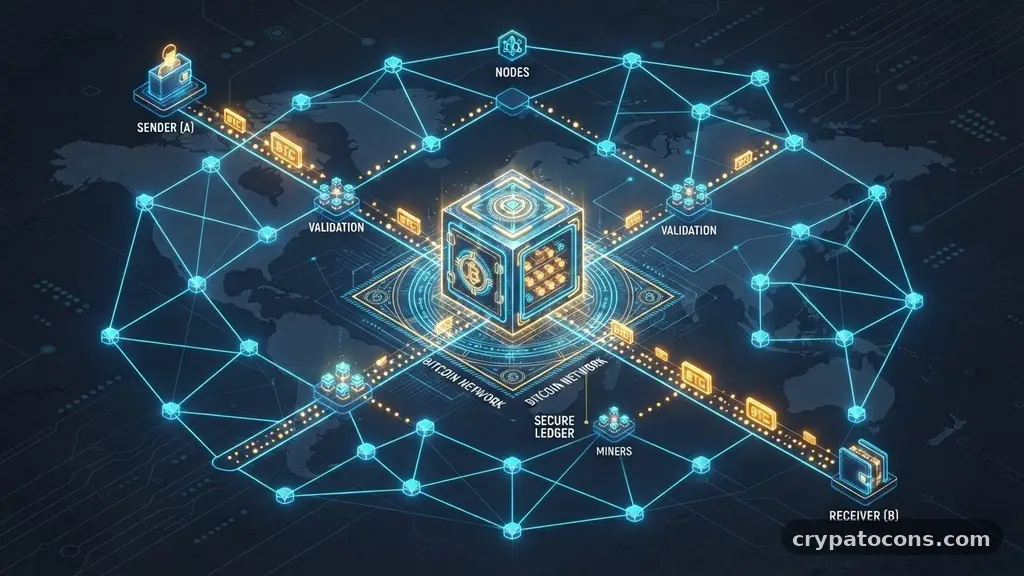
When you initiate a transfer, the process begins in your digital wallet. Your software creates a cryptographic signature using your private key, which acts as a digital proof that you have the right to spend those specific coins. This transaction is then broadcast to the surrounding network of nodes, which are essentially computers running the Bitcoin software.
Once the nodes receive your broadcast, they don’t immediately finalize the transfer. Instead, they perform a series of checks to ensure the transaction is valid according to the protocol rules. They confirm that the digital signature is correct, that the sender actually owns the funds, and that those funds haven’t been spent already.
If a transaction passes these initial checks, it enters a temporary waiting area known as the mempool. The mempool acts as a holding pen where pending transactions wait to be picked up by miners. Because the network has a limited capacity for how many transfers can be included in each block, users often include a small fee to incentivize miners to prioritize their specific request.
The Role of Miners in Verification
Miners are the specialized participants who do the heavy lifting in the verification process. They collect groups of pending transactions from the mempool and bundle them together into a candidate block. Their goal is to solve a complex mathematical puzzle, a mechanism known as proof of work, which requires significant computational power.
This puzzle involves finding a specific hash—a long string of characters—that meets the network’s current difficulty requirements. Because this process is computationally expensive, it prevents bad actors from easily spamming the network or rewriting past history. The first miner to find the correct hash broadcasts the completed block to the rest of the network for final validation.
Other nodes then quickly check that the miner’s work is correct and that the included transactions follow all protocol rules. If the majority of the network agrees, the block is appended to the existing chain of previous blocks. This creates an immutable record that is extremely difficult to alter or delete.
Understanding Proof of Work
Proof of work is the engine that keeps the entire system secure and decentralized. It forces participants to commit real-world resources, specifically electricity and hardware, to participate in the maintenance of the network. This creates a physical cost for verification, ensuring that those who validate transactions have a vested interest in the system’s integrity.
You might wonder why this energy expenditure is necessary for digital currency. Without a cost to verify, it would be trivial for an attacker to create thousands of fake identities and overwhelm the system with fraudulent data. By requiring proof of work, Bitcoin ensures that the majority of the network is honest, as the cost of subverting the system would far outweigh any potential gain.
The difficulty of this puzzle automatically adjusts every 2,016 blocks, or roughly every two weeks. If more miners join and compute faster, the difficulty rises to keep block production consistent at approximately 10 minutes. If miners leave, the difficulty drops, ensuring that the network remains functional regardless of how many people are actively participating.
The Structure of the Blockchain
The blockchain serves as the public ledger where all verified activity is permanently stored. Each block contains a header that includes a reference to the previous block’s hash, effectively chaining them together in chronological order. This structure makes the entire history of the network transparent and auditable by anyone with an internet connection.
Because every block links to the one before it, changing a transaction in an old block would require re-doing the proof of work for that block and every subsequent block. As more blocks are added to the chain, the cost and effort required to alter history increase exponentially. This is why a transaction is considered more “secure” the deeper it gets buried under newer blocks.
To visualize how data is organized, consider the following comparison of how information moves through the system compared to a traditional bank:
| Feature | Bitcoin Network | Traditional Banking |
|---|---|---|
| Validation | Decentralized Miners | Centralized Clearinghouse |
| Speed | ~10 Minute Blocks | Days for Settlement |
| Transparency | Publicly Auditable | Private/Proprietary |
| Availability | 24/7/365 | Business Hours |
Why Cryptography is Essential
Cryptography is the foundation upon which all digital ownership is built. It allows users to prove they own their funds without needing to reveal their actual identity or share their private keys with anyone. Through public-key cryptography, you generate a public address—which you share to receive funds—and a private key, which you keep secret to sign and authorize your spending.
When you send Bitcoin, your wallet uses your private key to generate a unique digital signature for that specific transaction. This signature acts like a tamper-proof seal that only you could have created. Because the network nodes have access to your public key, they can mathematically verify that the signature is authentic without ever seeing your private key.
This ensures that only the rightful owner can move their assets. If a malicious party tried to broadcast a transaction claiming to be you, they would be unable to produce the correct digital signature required by the network. The nodes would immediately reject the request as invalid, keeping your balance safe from unauthorized access.
Common Risks and Security Considerations
While the underlying protocol is incredibly secure, users must still exercise caution when interacting with the network. The most common risks are not related to the protocol being “hacked,” but rather to human error or malicious third-party services. If you lose your private keys or seed phrase, you lose access to your funds forever, as there is no “forgot password” button for a decentralized ledger.
Users should also be wary of phishing attempts and fraudulent platforms that claim to “accelerate” or “verify” transactions for a fee. Legitimate Bitcoin documentation emphasizes that transactions are processed solely by the network of miners and that no third-party service can bypass the standard verification time. Always verify the address you are sending to, as blockchain transactions are irreversible once they are confirmed.
Here are a few key practices to ensure your transactions remain secure:
- Store your private keys in a cold, offline environment rather than on a computer connected to the internet.
- Always double-check the destination address before hitting the send button to avoid permanent loss.
- Use reputable hardware wallets to manage your private keys securely.
- Be skeptical of any website or individual promising “guaranteed” returns or asking for your recovery phrase.
- Monitor your transactions using a trusted blockchain explorer to see the status of your transfer in real-time.
The Role of Nodes in the Network
While miners are responsible for creating new blocks, full nodes are the backbone of the network’s decentralized nature. A full node is a computer that stores the entire history of the blockchain and independently verifies every transaction and block against the protocol’s rules. By running a full node, you don’t have to trust anyone else to tell you the current state of the ledger; you can see it for yourself.
Full nodes reject any block or transaction that violates the protocol, even if a powerful miner tries to include it. This creates a system of checks and balances where the miners provide the security, but the nodes provide the enforcement of the rules. This ensures that the protocol remains resistant to censorship and unauthorized changes.
The more people running full nodes, the more resilient the network becomes. It prevents any single entity or group of miners from colluding to change the rules of the system. This distributed verification is what makes the network so robust compared to traditional databases that rely on a single point of failure or a central administrator.
Frequently Asked Questions
How long does it take for a transaction to be verified?
On average, a block is found every 10 minutes. A transaction is considered “confirmed” once it is included in a block, though most exchanges wait for 3 to 6 confirmations before allowing you to move the funds to ensure the transaction is irreversible.
Can the FBI or other authorities track my transactions?
The Bitcoin blockchain is a public ledger, meaning every transaction is visible to anyone. While the network does not require your name or personal information, law enforcement can use sophisticated chain analysis tools to link public addresses to real-world identities if you have interacted with regulated exchanges or services.
What happens if a transaction is not verified?
If a transaction is not included in a block, it remains in the mempool. Eventually, it may be dropped from the mempool if it is not picked up by miners, or you can choose to “bump” the fee to encourage miners to include it in the next available block.
Is it possible to reverse a Bitcoin transaction?
No, once a transaction has been confirmed by the network and added to a block, it is effectively permanent. There is no central authority to call for a refund, which is why it is critical to ensure your recipient information is accurate before sending.
Closing Thoughts
Understanding how does Bitcoin transaction verification work reveals the brilliance of a system built on open, transparent mathematics rather than private, centralized trust. By leveraging a global network of miners and nodes, the protocol ensures that every movement of value is verified, secure, and permanent. Whether you are an active investor or simply curious about the underlying technology, recognizing the roles of proof of work and cryptography provides a solid foundation for your journey.
As you continue to explore this space, remember that the power of the network lies in its decentralized nature, which keeps the system accessible and fair for everyone globally. Keep your private keys secure, stay informed about best practices, and enjoy the experience of interacting with a truly borderless financial system.