How Does Bitcoin Mining Work?: A Technical Breakdown?
Understanding how does Bitcoin mining work is essential for anyone curious about the mechanics of decentralized finance. At its core, this process serves as the backbone of the entire Bitcoin ecosystem, ensuring that every transaction remains secure and verified without the need for a central bank.
By solving complex mathematical puzzles, participants help maintain the integrity of the ledger, earning digital rewards for their computational contributions. This article explains the technical requirements, the underlying incentives, and the environmental considerations involved in the process, providing a clear picture of how digital assets are created and how the network maintains its global stability.
The Core Mechanism of Verification
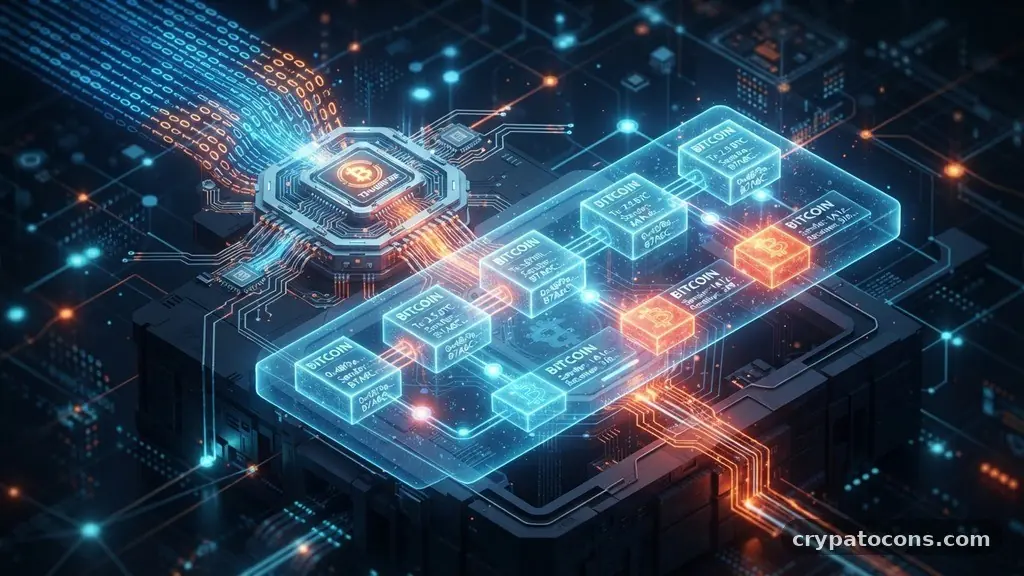
The primary function of Bitcoin mining is to validate and record transactions onto the blockchain. When a user sends Bitcoin, that information is broadcast to the network and grouped into a structure called a block. Miners compete to solve a cryptographic puzzle known as a hash, which acts as a digital fingerprint for the data within that block.
The first miner to successfully discover the correct hash broadcasts their solution to the network for verification. Once other participants confirm the solution is accurate, the block is officially added to the chain. This distributed verification process ensures that no single entity can alter the history of transactions, providing a level of security that traditional banking systems struggle to match.
The difficulty of this puzzle adjusts automatically every 2,016 blocks, or roughly every two weeks. This adjustment ensures that regardless of how many people are participating, a new block is produced approximately every ten minutes. This stability is vital for the network to remain predictable and functional for users worldwide.
Understanding Cryptographic Hashing
At the heart of the process is the SHA-256 algorithm, a mathematical function that turns any amount of data into a fixed-length string of characters. Miners use their hardware to guess this output by constantly changing a variable called a nonce. They perform trillions of calculations per second, hoping to find a hash that meets the network’s current difficulty target.
This process is essentially a high-stakes lottery where the computing power acts as your ticket. Because the algorithm is one-way, you cannot reverse-engineer the input from the output, which is why trial and error is the only way to solve it. This brute-force approach is exactly what makes the network so secure against potential attacks.
If someone wanted to compromise the blockchain, they would need to control more than 50% of the network’s total computing power. This is known as a 51% attack, and it is economically and physically impractical for any single actor to achieve. The sheer scale of the global network makes such an attempt prohibitively expensive and unlikely to succeed.
The Role of Mining Rewards
Miners are incentivized to dedicate their energy and hardware to the network through block rewards and transaction fees. When a miner successfully solves a block, they receive a specific number of newly minted Bitcoins. This serves as the primary mechanism for introducing new coins into circulation.
The reward for miners is cut in half every 210,000 blocks, an event known as the “halving” that occurs roughly every four years. This built-in scarcity is a fundamental part of the protocol’s design, intended to mirror the finite nature of precious metals like gold. As the block reward decreases, miners must rely more heavily on transaction fees paid by users.
| Event | Year | Block Reward |
|---|---|---|
| Genesis | 2009 | 50 BTC |
| First Halving | 2012 | 25 BTC |
| Second Halving | 2016 | 12.5 BTC |
| Third Halving | 2020 | 6.25 BTC |
| Fourth Halving | 2024 | 3.125 BTC |
Hardware Evolution and Efficiency
In the early days of Bitcoin, enthusiasts could mine using standard home computers or even laptops. As the network grew, the competition for rewards intensified, leading to the development of specialized hardware. Today, the industry is dominated by Application-Specific Integrated Circuits, or ASICs.
These machines are designed for one purpose: to perform the SHA-256 hashing algorithm as efficiently as possible. Because they are so specialized, they offer significantly higher performance than general-purpose hardware like CPUs or GPUs. For a deeper look at the technical standards behind these protocols, you can review the documentation provided by the official Bitcoin project.
Energy efficiency has become the primary metric for success in the industry. Miners constantly seek out cheaper electricity and more advanced cooling solutions to keep their operations profitable. This competitive pressure drives innovation in hardware manufacturing, pushing companies to produce faster and more energy-efficient chips every year.
The Economics of Mining Operations
Running a profitable mining operation requires careful planning and significant capital investment. Beyond the cost of purchasing ASICs, operators must account for electricity rates, data center cooling, and maintenance of the equipment. Because profit margins can be thin, location is often the most important factor for success.
Many large-scale operations are situated in regions with abundant renewable energy or excess power capacity. By utilizing electricity that would otherwise go to waste, these miners can reduce their overhead and remain competitive. This geographical distribution helps decentralize the network, as mining power is spread across various jurisdictions and power grids.
* Electricity Costs: The single largest ongoing expense for any mining facility.
* Hardware Depreciation: Mining rigs lose value as newer, more efficient models hit the market.
* Network Difficulty: As more miners join, the individual share of rewards per unit of power decreases.
* Transaction Fees: These provide a secondary income stream that fluctuates based on network activity.
Environmental and Energy Considerations
The energy consumption of the Bitcoin network is a frequent topic of debate, given the high amount of electricity required to secure the blockchain. Critics argue that the process is wasteful, while proponents point out that much of the energy used comes from stranded or renewable sources. The transparency of the network allows researchers to estimate the total power usage with a high degree of accuracy.
Many mining firms are now integrating directly with energy providers to help balance the grid. By adjusting their consumption based on real-time demand, miners can prevent power surges and provide a flexible load for utility companies. This relationship is evolving as the industry moves toward more sustainable energy sources to improve its public image and operational longevity.
The environmental impact is ultimately a function of the energy mix used by miners. As global energy grids transition toward wind, solar, and hydroelectric power, the carbon footprint of the mining industry is expected to decline. This shift is not just a matter of corporate responsibility but a strategic move to ensure long-term regulatory compliance.
Mining Pools and Collaborative Efforts
Because the probability of a single individual finding a block with a personal machine is extremely low, most miners join pools. A mining pool is a group of participants who combine their computational resources to increase their chances of solving a block. When the pool succeeds, the rewards are distributed among members based on the amount of work they contributed.
This cooperative approach makes participation accessible to smaller operators who would otherwise be unable to compete with massive industrial farms. It smooths out the variance in income, providing a more consistent return on investment for participants. Joining a pool is standard practice for almost everyone involved in the industry today.
Pool operators typically charge a small fee for their services, which covers the cost of managing the infrastructure and coordinating the participants. While this takes a small cut from the individual’s earnings, the trade-off for reliability is generally considered worth it. It is a prime example of how the ecosystem adapts to remain inclusive and efficient.
Security and Decentralization
The ultimate goal of mining is to maintain a decentralized ledger that no single government or corporation can control. By requiring physical energy and hardware to validate transactions, the network creates a “proof of work” that is difficult to forge. This reliance on the laws of physics and mathematics provides a foundation of trust that is independent of human intervention.
Decentralization is the key to Bitcoin’s censorship resistance. Because miners are distributed across the globe, it is virtually impossible for any single entity to shut down the network. Even if a specific country were to ban mining, the infrastructure would simply migrate to a more welcoming jurisdiction, ensuring that the blockchain continues to function.
This resilience is why Bitcoin has remained operational for over a decade without a single successful hack of its core protocol. Every transaction is permanently etched into the history of the chain, protected by the collective effort of thousands of miners. It is a robust system designed to survive even the most volatile global conditions.
Frequently Asked Questions
How long does it take to mine a single Bitcoin?
The time it takes to mine one Bitcoin depends entirely on your hardware and the total network hashrate. Because the network adjusts difficulty to keep block times at ten minutes, an individual miner with limited equipment might never mine a full block on their own, which is why most people join pools.
Does Bitcoin mining really pay?
It can be profitable, but it is highly dependent on your electricity costs and the efficiency of your hardware. With the current market volatility and the halving cycles, many miners operate on thin margins and must manage their expenses aggressively to remain in the green.
What happens when all 21 million Bitcoins are mined?
Once the supply limit is reached, miners will no longer receive new block rewards. Instead, they will rely entirely on transaction fees to incentivize them to continue securing the network. This transition is expected to happen around the year 2140.
Is it legal to mine Bitcoin?
In most parts of the world, mining is legal, though regulations vary by jurisdiction. Some countries have specific tax laws regarding digital assets, while others have placed restrictions on energy-intensive operations. It is important to check your local laws before setting up any mining equipment.
Closing Thoughts
Learning how does Bitcoin mining work reveals a fascinating intersection of economics, cryptography, and engineering. It is a system built on the principle of distributed trust, where energy serves as the currency of security. By participating in this process, miners do more than just earn rewards; they sustain a global financial network that operates beyond the reach of traditional institutions.
If you are interested in getting involved, start by researching the specific hardware requirements and energy costs in your area. Joining a reputable mining pool is the most effective way to begin, as it provides the stability needed to see consistent results.
Whether you view mining as an investment, a technical hobby, or a way to support a decentralized future, understanding the underlying mechanics is the first step toward successful engagement. The network will continue to evolve, and staying informed is the best way to navigate this landscape.